Disclaimer: This post is for informational purposes only and does not encourage purchasing or using fake IDs.
Every year, customs officers seize thousands of fake IDs hidden inside everyday items shipped from China. In August 2024 alone, more than 1,000 were intercepted at Chicago O’Hare, with another major wave arriving before the spring college semester.
And IDGod always appears in the list.
It is operating since 2004, it has outlasted countless competitors, domain seizures, and crackdowns. More than two decades later, the operation continues to evolve and stay active.
Search for IDGod today and you’ll find a mess of copycat websites, conflicting reviews, and recycled information that rarely explains what’s really happening behind the scenes.
Today, you’ll learn how fake IDs are produced, which IDGod sites are connected to the original operation, what the legal risks actually look like, what changed in 2025, and why people still get caught even when carrying a convincing ID.
Which IDGod Website is Real?
Before you even think about quality, pricing, or delivery, there’s a bigger problem: finding the real IDGod website.
Search “IDGod” and you’ll see dozens of lookalike domains like IDGod.com, IDGod.to, IDGod.org, IDGod.net and more claiming to be the original. Some have similar names, copied branding, and even fake reviews designed to look trustworthy.
This is where many buyers get burned.
The domain most consistently associated with the original operation is IDGod.ph.
The typical scam is simple. You send cryptocurrency, receive an order confirmation, and then nothing happens. No shipment. No response. No refund.
What makes this worse is the personal information involved. Most fake ID orders require a photo, name, date of birth, address, and signature. In the wrong hands, that’s valuable data.
Many copycat IDGod sites exist for one reason to collect payments and personal information from unsuspecting buyers.
What Is IDGod?
IDGod is one of the oldest names in the fake ID market. The operation traces its roots back to 2004 after the collapse of an earlier vendor known as IDChief. According to long-running community discussions, some of the people behind IDChief launched IDGod and continued operating under a new name.
More than 20 years later, it’s still active while many competitors have disappeared.
Today, IDGod offers IDs for more than 40 U.S. states and several Canadian provinces. Prices generally start around $50, with discounts for larger orders and a free duplicate included with most purchases.
Payments are made through Bitcoin or Monero. While Bitcoin transactions are recorded on a public blockchain, Monero is designed with stronger privacy features, which is one reason it’s popular among buyers who want greater anonymity.
Over the years, competitors such as Old Ironsides, IDTOP, and Bogus Braxtor have come and gone, but IDGod remains one of the most frequently discussed names in fake ID communities.
How Fake IDs Are Actually Made
Most people think a fake ID succeeds or fails based on the photo, font, or design.
That’s only part of the story.
The best fake IDs don’t just look real. They have to feel real, scan correctly, and match dozens of security features found on legitimate driver’s licenses.
The Card Itself Matters More Than Most People Think
Before a bartender checks your birthday or a bouncer compares your photo, they often make a quick judgment based on the card in their hand.
Real U.S. driver’s licenses are made from specialized materials such as polycarbonate or Teslin. These materials have a unique weight, texture, and flexibility that cheap cards struggle to replicate.
Experienced staff handle hundreds of IDs every week. If a card feels wrong, suspicion starts immediately.
Modern IDs Contain Multiple Security Features
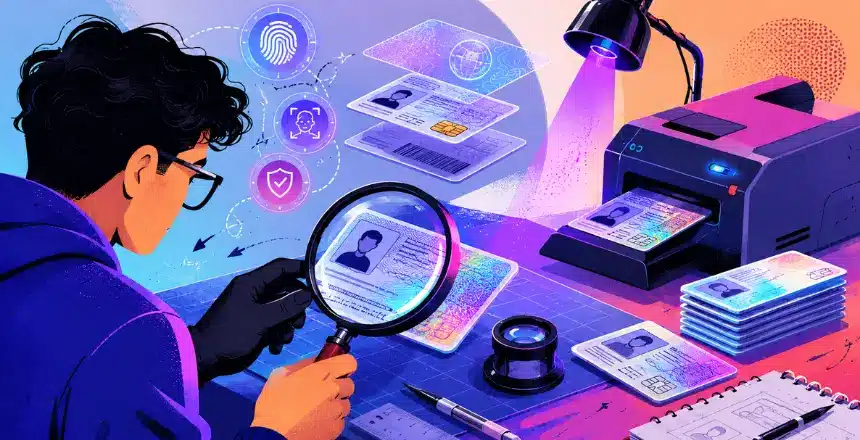
A convincing fake ID has to imitate far more than a printed design. Most state-issued licenses include several layers of security, including:
- Holograms that change appearance under different angles
- UV elements visible only under blacklight
- Laser-engraved text embedded into the card
- Scannable barcodes
- Magnetic stripes used by some verification systems
A fake doesn’t need to perfectly duplicate every feature. It only needs to survive the checks it’s likely to encounter.
Why Barcodes Are the Biggest Challenge
Among all security features, the barcode is often the hardest obstacle.
A fake ID can look convincing, feel authentic, and even pass a quick visual inspection. But if a verification system checks whether the encoded information matches a real person in a DMV database, the card can fail instantly.
That’s why a realistic appearance doesn’t always guarantee success.
Templates Become Outdated Faster Than People Realize
States regularly update their driver’s license designs. New holograms, revised layouts, updated state seals, and repositioned security elements can make older templates easier to spot.
Keeping up requires constant updates.
According to data from IDScan.net, common reasons fake IDs are flagged include incorrect physical details such as height, eye color, or other information that doesn’t align with the person presenting the card.
In many cases, people assume they’ll be caught because the card looks fake. More often, it’s a small inconsistency that attracts attention.
What Changed in 2025?
Most fake ID discussions focus on card quality, scanners, or shipping. The bigger change happened behind the scenes.
In August 2025, the FBI and Dutch police shut down VerifTools, a platform used to create fake identity documents. What investigators found was staggering 915,655 fake documents generated by 636,847 registered users between May 2023 and August 2025.
The platform wasn’t just serving people trying to get into bars. According to investigators, criminals were using fake identities to bypass Know Your Customer (KYC) checks at cryptocurrency exchanges, access stolen accounts, and commit financial fraud. U.S. identity documents alone generated roughly $1.47 million in purchases during the 13 months before the takedown.
But the most important part of the story came after the seizure.
The operators reportedly relaunched on a new domain the same day authorities took the servers offline. Meanwhile, investigators gained access to the platform’s user database.
In April 2026, Dutch police announced arrests linked to data recovered from those servers. Several suspects were identified months after the original takedown, highlighting a reality many users overlook: when a fake ID platform gets seized, the risk doesn’t necessarily end when the website disappears.
For years, the biggest concern was whether a fake ID would work. Increasingly, the bigger question is who has access to the database behind it.
The Legal Risk Most People Underestimate
When people think about fake IDs, they usually think about getting caught at a bar, liquor store, or traffic stop.
The legal consequences can be much bigger than that.
At the federal level, fake identification offenses can fall under 18 U.S.C. § 1028, which covers fraudulent identification documents and related offenses. Depending on the circumstances, penalties can include substantial fines and prison sentences that may reach 15 years or more in serious cases.
State penalties vary, but they’re often more severe than people expect:
- Florida: Certain fake ID offenses may be charged as a third-degree felony.
- New York: Possession or use of forged identification can lead to felony-level charges under forgery statutes.
- Illinois: Repeat offenses can result in felony charges, along with potential driver’s license suspension.
- Iowa: Courts may impose license suspensions in addition to criminal penalties.
- Across the U.S.: Penalties can include fines, probation, community service, license suspension, and criminal convictions depending on the circumstances.
What catches many people off guard isn’t the initial punishment. It’s what happens afterward.
A fraud-related conviction can affect background checks, professional licensing, government jobs, financial industry careers, law school admissions, medical programs, and other opportunities for years after a case is closed.
International students face additional concerns. Depending on the circumstances, even a criminal charge can create visa complications or immigration issues.
For many people, the lasting consequences end up being far more significant than the fine or court appearance itself.
Why Getting Away With It Is Becoming Harder
The fake ID game isn’t changing just because IDs are getting better. Businesses are getting better at spotting them.
Several states have increased penalties for businesses that serve underage customers, and more bars, liquor stores, and dispensaries now rely on electronic ID scanners instead of quick visual checks. For business owners, a missed fake ID can lead to fines, license suspensions, and regulatory scrutiny.
The result is simple: verification is becoming stricter.
The data supports that trend. According to IDScan.net’s analysis of more than 130 million ID scans, most fake ID attempts don’t involve people pretending to be from another state. In fact, 71% of attempts use IDs from the user’s own state.
Another interesting finding is that the most commonly listed age isn’t 21. It’s 23. Many users appear to believe a slightly older age attracts less attention.
Fake ID activity also follows predictable patterns. Attempts spike during back-to-school season, Halloween, New Year’s Eve, and other periods when bars, clubs, and retailers expect higher demand from younger customers.
The takeaway is straightforward fake IDs are no longer being checked only by bartenders and bouncers. Increasingly, they’re being checked by technology.
How Fake IDs Actually Get Caught
Many people assume fake IDs get caught because they look fake.
That’s rarely the whole story.
In most cases, fake IDs are flagged for one of four reasons:
ID Scanners
This is the biggest obstacle today.
Modern scanners can do far more than read a barcode. Some systems compare the encoded information against trusted databases and can spot inconsistencies that aren’t visible to the human eye.
A fake ID might pass a quick visual check but fail the moment it’s scanned.
Security Feature Checks
Many bars, clubs, and retailers use UV lights or other tools to verify security features built into legitimate driver’s licenses.
If a hologram looks wrong, a UV pattern appears in the wrong place, or a security element is missing, the card can raise suspicion immediately.
Human Error
Sometimes the card isn’t the problem.
Staff who check IDs every night notice small details that others miss. An incorrect height, eye color, birth year, or physical description can be enough to trigger additional questions.
According to IDScan.net data, incorrect physical details are among the most common reasons fake IDs are flagged.
The Person Holding It
This catches more people than they expect.
A hesitation when answering basic questions, uncertainty about personal details, or nervous behavior can draw attention even when the card itself looks convincing.
In other words, getting caught isn’t always about the quality of the ID. Sometimes it’s about the technology checking it. Sometimes it’s about the person using it.
The Risk Most Buyers Ignore
Most discussions about fake IDs focus on whether the card works or what happens if you get caught using it.
The risk actually starts much earlier.
To place an order, buyers typically submit a photo, date of birth, address, signature, and other personal details. In other words, they hand over enough information to identify themselves to people they’ve never met and will likely never know.
That creates a different kind of exposure.
If the vendor is dishonest, the information can be misused. If the platform is compromised, the data can be exposed. And if law enforcement gains access to customer records, those details may remain available long after the website disappears.
The VerifTools case is a good example. When authorities seized the platform’s servers, they didn’t just shut down a website. They gained access to hundreds of thousands of user records and continued investigating those records well after the original takedown.
This is the part many buyers overlook. A fake ID can be replaced. A leaked photo, address, signature, or personal record can’t be taken back once it’s been shared.
Fake IDs Aren’t Just About Bars and Clubs
When most people think about fake IDs, they picture college students trying to buy alcohol or get into a bar.
The reality is much bigger.
Investigations in recent years have shown that fake identity documents are also used in financial fraud, account takeovers, identity theft, and attempts to bypass identity verification systems. The same technology used to create a fake driver’s license can be used to open accounts, pass KYC checks, or impersonate someone else online.
That’s one reason law enforcement agencies take the market seriously.
In a 2025 statement, U.S. Customs and Border Protection noted that fraudulent identity documents are frequently linked to broader criminal activity, including identity theft and other forms of organized fraud.
The takeaway is simple: fake IDs don’t exist in isolation. What starts as a document designed to prove age can also become part of a much larger identity fraud ecosystem.
Why Fake IDs Are Getting Harder to Use
The technology used to verify IDs is improving faster than most people realize.
Modern scanners can analyze far more than a barcode, while digital driver’s licenses and mobile IDs are becoming more common across the United States. Several states are also exploring biometric verification tied to fingerprints or facial recognition.
The long-term trend is clear: identity checks are becoming more digital, more automated, and harder to bypass with a physical counterfeit alone.
Frequently Asked Questions
Does IDGod still work in 2026?
IDGod.ph is still operating in 2026. Whether a fake ID succeeds depends largely on how it’s being checked. Some may pass basic visual inspections, while advanced scanners and database-backed verification systems are much harder to bypass.
Which IDGod site is actually the real one?
The domain most commonly associated with the original operation is IDGod.ph. Many other websites using the IDGod name have been reported as copycats or scam sites, which is why buyers are often advised to verify the domain carefully before placing an order.
Can IDGod fake IDs pass a barcode scanner?
Some fake IDs can pass basic barcode scans that only check formatting. More advanced verification systems that cross-reference identity information against trusted databases are far more difficult to fool.
Is buying a fake ID from IDGod a felony?
Yes. Fake ID laws vary by state, but possession, use, or purchase of fraudulent identification can lead to criminal charges, fines, license suspensions, and, in some cases, felony offenses.
Which states get faked most often?
Poor card quality is only one reason. Many fake IDs are flagged by scanners, security feature checks, incorrect personal details, or the behavior of the person presenting the card.
What’s the biggest risk besides getting caught?
Many buyers focus on the ID itself and overlook the personal information required to place an order. Photos, addresses, signatures, and other details can remain stored by vendors long after a transaction is completed.
You may also like: